
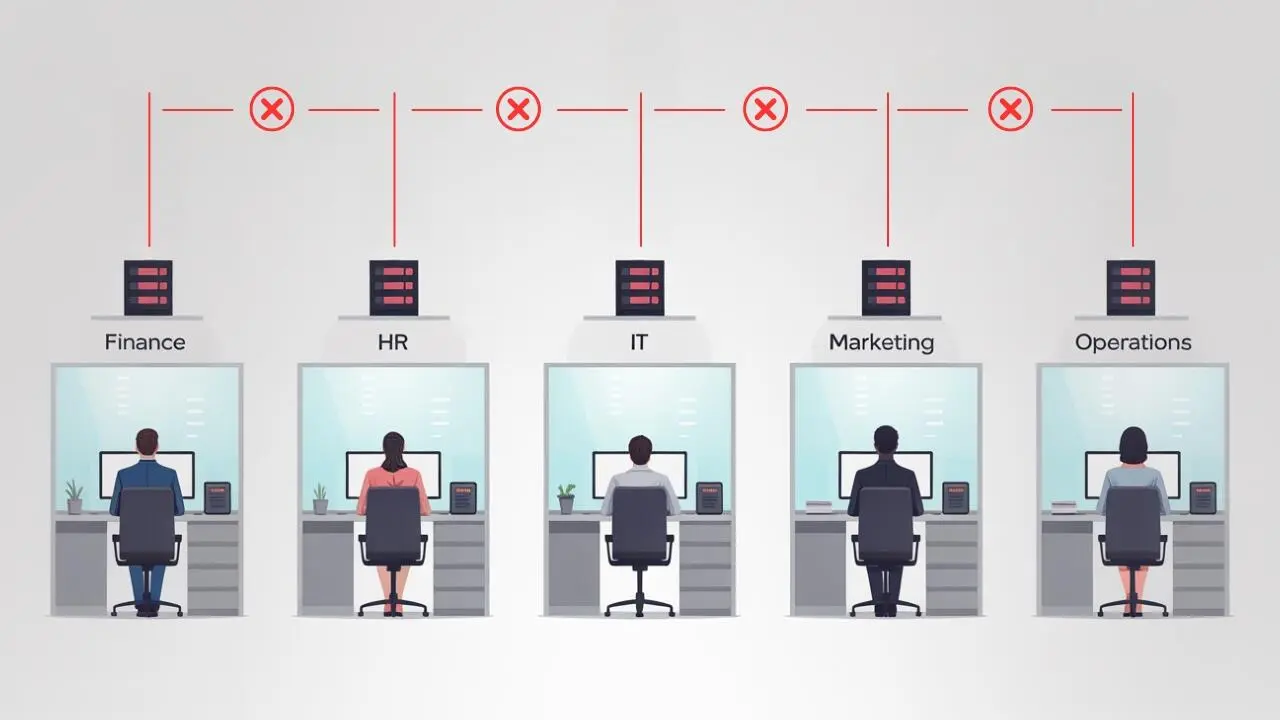
When your tools don’t talk to each other, neither do your teams.
And when your teams don’t talk to each other – at least not through clear, reliable systems – things fall apart.
In the early days of a startup or small business, it’s easy to get away with a little chaos. A few spreadsheets here, a Trello board there, a shared inbox somewhere in between – it all works because there are only a few people involved, and everyone’s talking constantly.
But as soon as you start to grow, that patchwork starts to tear. The tools don’t scale. The updates fall through the cracks. And the people who were once perfectly in sync now feel like they’re working in separate companies.
That’s the silent cost of data silos – and most businesses don’t see the damage until it’s already slowing them down.
When Sales Closes, But Operations Doesn’t Know
Let’s say your sales team just closed a deal. They’ve had a great call, sent a proposal, and marked the lead as “Won” in the CRM.
Celebration emoji in Slack. High fives all around.
But operations?
They didn’t get the memo.
Why?
Because the CRM isn’t connected to the project management tool.
Because the product details were shared in a PDF.
Because the handoff happened in someone’s head, not in a system.
So ops is left guessing.
- What exactly was sold?
- What are the delivery timelines?
- Who’s responsible for next steps?
- Where’s the contract?
This kind of breakdown doesn’t happen once. It happens daily in siloed teams. And every time it does, it chips away at speed, trust, and efficiency.
Repeating the Same Updates, Fixing the Same Mistakes
When teams work in isolated tools – one for CRM, another for inventory, one for accounting, and another for support – they end up becoming gatekeepers of information that others need.
So what happens?
- Sales has to “check with ops” before promising a delivery date.
- Ops has to “check with accounts” before shipping.
- Support has to “check with sales” to see if this customer is under warranty.
Everyone’s asking for the same information again and again – across teams, across tools, across time zones.
And no one has confidence in what they’re seeing.
So they send emails. Or create their own trackers. Or update a shared sheet (which is already outdated).
And just like that, a fast-growing business starts moving slower than ever.

The Human Cost: Friction, Frustration, and Finger-Pointing
Let’s zoom out from tools and talk about people.
Because at the heart of every broken workflow is a team that’s trying to do their best – but working with broken systems.
- The support agent who missed a client’s urgent request because it wasn’t tagged properly.
- The finance team chasing down invoice details buried in a sales email chain.
- The ops lead who shipped the wrong package because the CRM note was unclear.
It’s not that people don’t care.
It’s that they’re working with incomplete, disconnected, and fragmented information.
And when mistakes happen – as they inevitably do – the blame starts.
“This should’ve been in the system.”
“Why didn’t you update the sheet?”
“I thought you were handling that.”
People stop trusting each other.
They start double-checking everything manually.
They get frustrated. They burn out.
And some of your best talent quietly leaves, not because they couldn’t handle the work – but because they couldn’t stand the chaos.
You Don’t Need More Tools – You Need Smarter Ones That Work Together
Here’s the thing: most companies don’t have a “lack of tools” problem.
They have a lack of integration problem.
Too many teams buy tools for specific functions – a CRM for sales, a ticketing system for support, an invoicing tool for finance – and assume it’s a good enough stack.
But when these tools don’t sync, they don’t serve the business. They serve departments.
The real solution is to build a connected ecosystem, where:
- Winning a deal in the CRM automatically triggers an onboarding project
- Inventory is updated the moment an order is confirmed
- Invoices are linked to signed contracts
- Support teams can view customer history and order status without asking around
This doesn’t just remove friction.
It brings clarity, accountability, and momentum.

Cost-Effective Doesn’t Mean Compromising
You might be thinking:
“Well sure, but connecting all these systems sounds expensive.”
Here’s the good news:
It doesn’t have to be.
Open-source, all-in-one platforms like ERPNext were built for exactly this use case.
They give you:
- CRM, inventory, accounting, support, HR – all in one place
- A single view of every customer, order, and ticket
- Custom workflows and automations – without needing multiple tools
And because it’s open-source, you can start small, scale gradually, and control your own data.
You don’t need a six-figure budget.
You just need to be tired of the chaos.
Closing: Better Communication Starts with Better Connection
If your teams feel disconnected, it’s probably not because they don’t want to collaborate.
It’s because the systems they’re using are working against them.
Don’t let silos slow your growth.
Don’t let handovers become hazards.
Don’t let tools create more problems than they solve.
Connect your workflows, and you’ll connect your people.
That’s how you scale without stress.
Comment with your current team size and I’ll share one integration idea that could instantly reduce friction in your ops. Or DM for a free checklist on where silos are costing you the most.