In the last two posts, we covered the model decision (augmentation vs dedicated team vs project outsourcing) and the location decision (nearshore vs offshore vs onshore).
Now comes the part that actually decides whether outsourcing feels like momentum—or like slow pain:
Hidden costs.
These are costs you won’t see in a vendor quote:
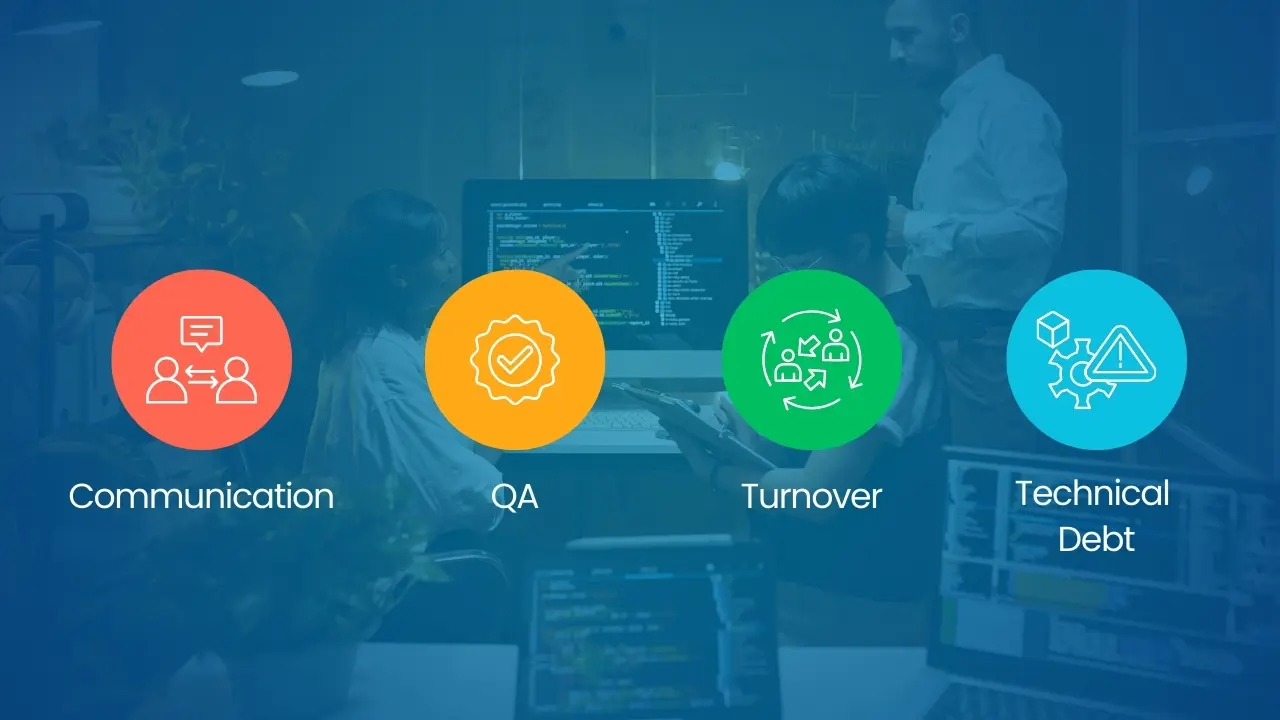
- the “time zone tax” in decisions
- rework that looks like progress (until QA)
- knowledge loss when people rotate
- technical debt that turns every new feature into a fight
And in 2026, there’s a multiplier: AI. It increases output, but it also increases the need for review gates, testing discipline, and governance (otherwise you scale mistakes faster). The 2024 DORA report explicitly measures factors like technical debt, documentation quality, and cross-functional coordination—because these are now core drivers of delivery performance.
Let’s break down the four hidden costs and exactly how CTOs prevent them.
The hidden-cost equation (why “cheap” becomes expensive)
A good outsourcing partnership reduces total cost of ownership. A weak one increases it—quietly.
One signal: the macro cost of poor software quality is massive. CISQ’s 2022 report estimates the cost of poor software quality in the U.S. at $2.41T, and accumulated software technical debt at about $1.52T. (CISQ)
You don’t need to be “at U.S. economy scale” to feel the same pattern:
- defects discovered late create rework loops
- unstable code increases review time
- poor documentation slows every handover
- coordination delays stall shipping
Hidden Cost #1: Communication & Coordination (the “time zone tax”)
What it looks like
- A simple question takes 24 hours to resolve
- Tickets bounce back and forth due to missing context
- “We built what you asked” but it’s not what you meant
- Sprint velocity looks okay… but release readiness is always shaky
Research on global/distributed software development consistently highlights persistent issues like communication barriers, time zone constraints, coordination difficulties, and trust/knowledge transfer challenges.
A systematic review on rework causes in Global Software Development also points to communication/coordination and requirements management as major drivers of rework.
Why it happens
Because communication isn’t a “tooling” problem. It’s an operating system problem:
- unclear ownership (who decides?)
- unclear definitions (what does “done” mean?)
- unclear interfaces (how does this integrate?)
How to eliminate it (practical fixes)
- Overlap hours (non-negotiable): 2–4 hours where decisions happen live
- Decision logs: short written decisions (what we decided + why)
- Async specs that don’t suck: screenshots, examples, acceptance criteria
- Weekly demos: working software, not status updates
This is why ARIS positions its delivery around a predictable rhythm (weekly demos, dashboards, structured governance) instead of ad-hoc communication.
You still cannot escape the human in the loop. You have just moved them earlier in the process.
Hidden Cost #2: QA Rework & Release Instability
What it looks like
- “QA is slowing us down” becomes a repeated complaint
- bug count spikes near release
- hotfix culture forms
- customers become your test team
Why it happens
When QA is treated as a phase instead of a gate:
- no definition of done
- noting starts too late
- staging environments don’t match production
DORA’s research has repeatedly shown that quality, review speed, documentation quality, and technical debt are not “nice-to-haves”—they correlate with how reliably teams ship.
How to eliminate it
- Shift-left QA gates: review + automated checks before merge
- Test strategy: automate what breaks often; manually test what’s risky/visual
- Release checklist: security scan, dependency review, smoke tests, rollback plan
- One staging truth: staging must mirror production enough to be meaningful
ARIS explicitly packages this as “Security, Compliance & Documentation Built-In” rather than afterthought work.
Hidden Cost #3: Turnover & Knowledge Loss (the silent killer)
What it looks like
- velocity drops every time someone changes
- the same issues repeat because context vanished
- “only one person knows this module” becomes normal
- onboarding is constant
Why it happens
Outsourcing often rotates people unless you buy continuity (and enforce it contractually).
When continuity breaks, you lose:
- architecture co
- tribal knowledge
- debugging instincts
Academic work on developer churn highlights how knowledge loss increases maintenance effort and explores strategies like knowledge diffusion/task assignment to reduce maintenance cost in churn scenarios (with significant savings in certain conditions).
Hidden Cost #4: Technical Debt & Integration Friction (why everything slows down)
What it looks like
- every feature takes longer than the last
- code reviews get slower
- bugs appear in unrelated areas
- integrations become fragile
- “we’ll clean it later” becomes permanent
A replication/extension study on technical debt reports developers often perceive a large chunk of time as wasted due to technical debt-related overhead (e.g., additional analysis and rework). (ScienceDirect)
Why it happens
Tecde. It’s:
- rushed architecture
- inconsistent patterns
- missing tests
- unclear interfaces
- “temporary” shortcuts that become permanent
ARIS’s own framing for AI-era delivery is blunt: “Most AI failures are actually tech-debt failures.”
Meaning: AI doesn’t hide weak foundations it exposes them.
How to eliminate it
- Debt register: track debt like bugs (severity + owner + payoff plan)
- Refactor budget: reserve 10–20% capacity per sprint for quality/cleanup
- Architecture guardrails: standards for APIs, modules, logging, error handling
- Integration spikes early: test risky integrations first, not last
And if leadership feels like the bottleneck: ARIS’s “Clarity Framework” calls out decision fatigue, integration drag, and invisible bottlenecks as root causes of slipping delivery not lack of effort. : why hidden costs get worse if governance is weak
Deloitte’s 2024 Global Outsourcing Survey notes 83% of executives are leveraging AI as part of outsourced services, but real benefits are often limited due to gaps in governance and contracting for AI requirements.
So add these checks to your outsourcing approach:
- AI tool policy: what’s allowed / what’s restricted (especially with client data)
- Verification rules: no AI-generated code merges without review + tests
- Cost controls: avoid surprise bills for AI feature usage
- Auditability: keep decisd safety measures

A simple CTO scorecard (to spot hidden costs early)
If you’re seeing 3+ of these, hidden costs are already accumulating:
- decisions routinely take 24+ hours
- QA happens “at the end”
- team members rotate without warning
- documentation is unreliable or missing
- integrations break late
- technical debt is never tracked
- releases need heroics
Fix isn’t “work harder.” It’s implement a delivery operating system—pod stability, QA gates, governance, and predictable shipping rhythm.
FAQs
Communication delays, QA rework, turnover/knowledge loss, and technical debt are the most common—and they directly affect delivery speed and total cost.
Enforce overlap hours, written decision logs, strong acceptance criteria, and weekly demos of working software (not status reports). Debt increase faster in outsourced projects?
Because speed pressure + unclear guardrails often leads to shortcuts without a payoff plan. Studies show technical debt can materially increase wasted developer time. AI reduce outsourcing costs?
AI can improve output, but without governance and contracting updates, benefits may be limited Deloitte highlights this gap directly in its 2024 survey.