
Most outsourcing projects don’t fail because the partner can’t build software. They fail because the contract leaves too much room for interpretation.
Scope becomes “assumptions”. SLAs exist on paper but don’t control outcomes. IP ownership is unclear. Change requests pile up. Then delivery slows down and trust drops.
This guide is a practical contract playbook for 2026. It shows how to structure a software outsourcing contract that protects speed and quality without turning every change into a legal fight.
Note: This is general guidance, not legal advice. Always align final contract wording with your legal counsel.
Table of Contents
- What makes outsourcing contracts break in real life
- The 4 documents you actually need (MSA, SOW, SLA, DPA)
- Scope that stays clear even when the roadmap changes
- SLAs that matter: delivery, quality, security, and support
- IP that’s clean: code, open-source, and AI-assisted work
- Change control that protects velocity (not bureaucracy)
- Security and third-party risk expectations in 2026
- Exit plan (write it before you need it)
- CTO contract checklist (copy-paste)
- FAQs
Key Takeaways
- A “good scope” is not a feature list. It’s boundaries + assumptions + acceptance criteria.
- SLAs should cover support and reliability, not just uptime.
- IP terms must explicitly cover custom deliverables, vendor background IP, open-source, and AI-assisted work.
- Change control is the only way to protect your roadmap when priorities move.
- If you sell into regulated sectors, supplier security and third-party risk clauses are becoming stricter.
1) What makes outsourcing contracts break in real life
These are the patterns that break contracts after week 2:
A) Scope is written at the wrong level
Either it’s too vague (“build an app”) or too detailed (200 features with no boundaries). Both cause conflict.
B) “Done” is not defined
Without acceptance criteria, every delivery turns into “it’s done” vs “it’s not done”.
C) SLAs exist, but they don’t control behaviour
Many SLAs are copied from IT support templates and don’t match software delivery reality.
D) Change happens informally
If change requests happen through calls or WhatsApp, your timeline will quietly collapse.
E) IP is assumed instead of written
This becomes painful later, especially if you re-platform, raise funding, or sell to enterprise buyers.
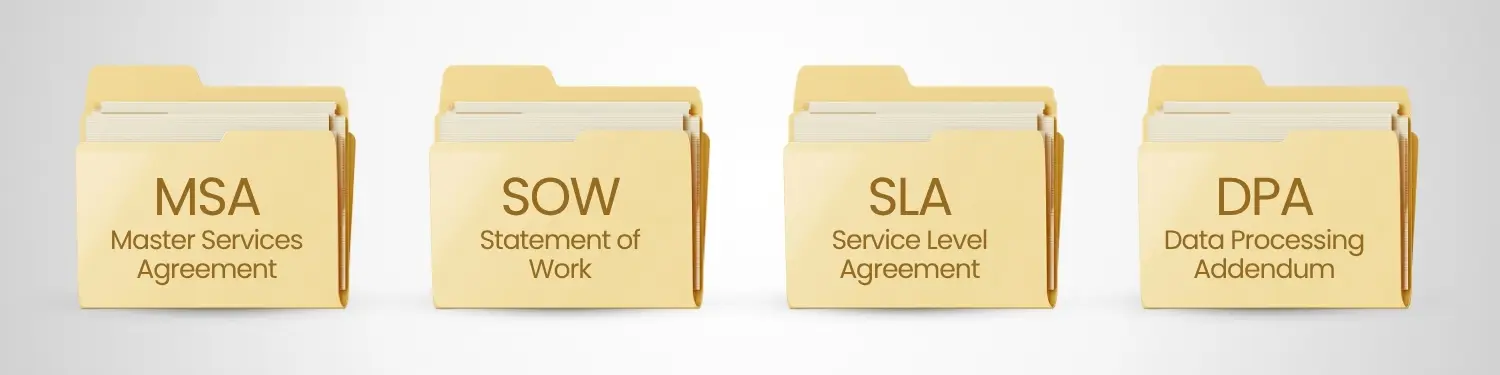
2) The 4 documents you actually need (and why)
Trying to put everything into one agreement usually creates confusion. A cleaner setup is:
1) MSA (Master Services Agreement)
The legal umbrella:
- confidentiality (or linked NDA)
- liability, warranties, disputes
- general commercial terms
2) SOW (Statement of Work)
The delivery blueprint:
- scope boundaries and deliverables
- assumptions and dependencies
- acceptance criteria and Definition of Done
- governance cadence (demos, reporting, escalation)
3) SLA (Service Level Agreement)
For support and operational expectations:
- severity levels (P0/P1/P2)
- response and resolution targets
- escalation process
- support hours and channels
4) DPA (Data Processing Addendum)
If personal data is involved:
- data handling and retention
- subcontractor rules
- breach notification
- deletion and exit procedures
This split keeps legal terms stable while delivery terms remain flexible.
3) Scope that stays clear even when the roadmap changes
A strong scope section answers one question:
What exactly are we delivering, and how will we agree it is done?
3.1 Scope should include boundaries
Instead of listing everything, define:
In scope
- modules and platforms included
- integrations covered (and who owns what)
- environments included (dev, staging, prod)
- deliverables: code, tests, docs, runbooks
Out of scope
- anything not included (write it plainly)
- migration work beyond agreed datasets
- new platforms not mentioned (e.g., mobile app if web-only)
3.2 Write assumptions and dependencies
This avoids “silent delays”:
- client provides access to repos/cloud/APIs by X date
- client reviews within Y business days
- vendor needs a single product owner decision-maker
- third-party approvals are outside vendor control
If assumptions break, the contract should allow timeline adjustments.
3.3 Acceptance criteria and Definition of Done
Do not accept “it’s done” as a feeling.
Add acceptance criteria such as:
- key scenarios pass (happy path + edge cases)
- tests pass (unit/integration where relevant)
- QA sign-off
- deployment notes shared
- docs updated
Then define Definition of Done once and reuse it in every sprint.
4) SLAs that matter: delivery, quality, security, and support
First rule: separate delivery expectations from support expectations.
4.1 Support SLAs (the ones most teams actually need)
Define:
- support hours (8×5, 12×5, etc.)
- channels (tickets, email, Slack/Teams)
- severity definitions
- response vs resolution targets
- escalation ladder
4.2 Quality SLAs (simple, practical)
Instead of vanity metrics, use:
- PR review required before merge
- defect severity rules + fix timelines
- release gate checks (smoke tests, regression pass)
- vulnerability remediation windows (if applicable)
4.3 Compliance note for 2026 (keep it simple)
If you sell into the EU:
- DORA applies from 17 January 2025 for EU financial entities and includes expectations around ICT and third-party risk management.
- The EU AI Act has a phased timeline and applies broadly from 2 August 2026 (with earlier and later phase-ins for specific sections).
- NIS2 introduces risk management and reporting expectations across critical sectors, including attention to supplier and third-party risk.
You don’t need to turn your contract into a regulatory thesis, but you do need stronger clauses on: audits, incident handling, supplier security, and exit planning.
5) IP that’s clean: code, open-source, and AI-assisted work
This is where “standard wording” causes expensive mess later.
5.1 Define who owns what
Split clearly:
Client-owned IP (typical)
- custom code written specifically for the client product
- project documentation, diagrams, runbooks
- test suites, automation scripts created for the project
Vendor background IP
- reusable frameworks, internal accelerators
- generic libraries used across clients
- tools that are not unique to your product
A common approach is:
- client owns project deliverables
- vendor retains background IP
- client receives a licence to use any vendor components required to run the deliverables
5.2 Open-source policy (do not skip)
Require:
- dependency disclosure
- licence review rules (especially copyleft if you want to avoid it)
- no unknown licence copy-paste
- SBOM requirement if enterprise customers demand it
5.3 AI-assisted development clause (2026 must-have)
Even if you’re not building AI features, teams may use AI tools during development.
Contract should state:
- which AI tools are allowed
- what data is forbidden in prompts (sensitive code, client data, secrets)
- human review is mandatory
- tests and security checks still apply
- ownership of deliverables remains standard once merged into the repo
This is exactly where AI changes contract expectations: AI can speed output, but it raises confidentiality and IP concerns if policies are unclear.
6) Change control that protects velocity (not bureaucracy)
Change control fails in two ways:
- too loose: everything changes informally, timeline breaks
- too strict: every change becomes a legal process, velocity dies
You want a lightweight system.
6.1 Define “normal backlog” vs “formal change request”
Normal backlog evolution
- refinement within agreed team capacity and sprint rhythm
Formal change request
Triggered when it changes:
- timeline baseline
- budget baseline
- compliance/security requirements
- major architecture direction
6.2 Use a one-page CR format
- what is changing
- why it matters
- impact on time/cost/risk
- options (fastest vs safest vs cheapest)
- approval owner
6.3 Trade-off rule (keep it honest)
If scope increases:
- timeline changes, or cost changes, or something else is removed
- If none change, quality becomes the hidden variable.
7) Security and third-party risk expectations in 2026
Security clauses need to be operational, not decorative.
Minimum items:
- least privilege access and offboarding timelines
- secrets handling policy
- vulnerability scanning expectations
- incident response ownership
- audit support process
For a practical baseline, many teams reference NIST’s SSDF as a common language for secure development expectations in procurement and supplier conversations.
If you sell into the EU and fall under NIS2 scope, supply chain security becomes part of cybersecurity risk measures, and organisations are encouraged to incorporate measures into contractual arrangements with direct suppliers.
8) Exit plan (write it before you need it)
A good exit clause protects you even if the relationship is great.
Include:
- notice period and transition support window
- what is handed over: repos, docs, runbooks, environments
- data deletion confirmation
- access transfer (no “hostage” risk)
- optional: escrow for critical situations (enterprise use cases)
9) Where this fits in the outsourcing cluster (internal links)
If you’re building this topic cluster on ARIS, add these internal links:
- Previous: How to Choose an Outsourcing Partner (Scorecard + Red Flags)
- Pillar: Offshore Software Development Outsourcing in 2026 (Models, Costs, Risks)
- Next: Outsourcing Pricing Models (Fixed Price vs T&M vs Dedicated Team)
This keeps the hub-and-spoke structure clean for SEO and user flow.
10) CTO Contract Checklist (copy-paste)
Scope
- Boundaries are written (in scope/out of scope)
- Assumptions and dependencies are explicit
- Acceptance criteria is measurable
- Definition of Done is written once and reused
Governance
- Demo cadence is defined
- Escalation path exists
- Named roles exist (delivery lead, tech lead, QA ownership)
SLAs
- Severity levels and response/resolution targets exist
- Support hours and channels are clear
- Quality gates are documented
IP + compliance
- Client ownership of deliverables is explicit
- Vendor background IP is defined and licensed
- Open-source policy and disclosure exists
- AI-assisted development policy exists
Change control
- Change request triggers are clear
- Lightweight CR template exists
- Trade-off rule is agreed (scope/time/cost)
Exit
- Transition support is written
- Handover deliverables are listed
- Data deletion and access transfer is clear
FAQs
Change control. Without it, scope expands informally and quality or timelines break.
Fixed price breaks when scope is unclear. Time-and-materials breaks when governance is weak. Many teams use a hybrid: fixed milestones with a flexible backlog.
Typically, the client owns custom deliverables after payment, while the vendor retains background IP. This must be written clearly.
Yes, because AI-assisted development is common. A simple policy clause prevents later confidentiality and ownership disputes.